Table of Contents
Study Material for Electrical Supervisor License Exams
Getting certified is now simpler than ever!
Overview
The Supervisor Certificate of Competency (SCC) is a mandatory statutory credential for professionals overseeing electrical installation work in India. While the core requirements are similar, specific rules, eligibility, and exam procedures are determined by the Electrical Licensing Board of each state.
Just One Click Away
How to buy the book?
Previewing a book before you buy is always a good practice. So go ahead—flip through a few pages of this incredible book. Preview the book.
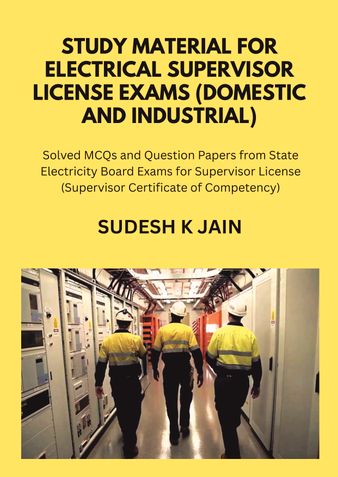
The book contains thousands of solved multiple-choice questions (MCQs) and question papers from State Electricity Board Exams for the Supervisor License (Supervisor Certificate of Competency). The book covers the following topics: Principles of Electricity and Materials, Electromagnetism, DC Machines, Batteries, AC Circuits, AC Machines, Transformers, Power Transmission and Distribution, Illumination, Power Generation, Testing and Measurement, Safety Measures, Rules and Codes (Electricity Acts 2003, 2010 and 2023 and IS codes 10028, 10118, 1646, 1866, 3043, 5571, 5572, 732 and 900), Domestic and Industrial Installation, Question Papers: MP ESL 2025-1, MP ESL 2025-2, MP ESL 2025-3, and a Downloads page. The book is written strictly according to the syllabus prescribed by the state electricity boards for supervisor license exams.
Frequently Asked Questions
Asked often. Answered once.
The Supervisor Certificate of Competency (SCC) is a statutory license issued by State Electrical Licensing Boards in India, which allows a person to legally supervise electrical installation, testing, and maintenance work as required under the Central Electricity Authority (Measures relating to Safety and Electric Supply) Regulations, 2010.
- Employment as an electrical supervisor in industries, construction sites, or with licensed electrical contractors.
- Obtaining or renewing an Electrical Contractor License (a contractor must employ at least one SCC holder).
- Signing test certificates and compliance forms for new electrical installations.
The certificate is issued in different grades or parts (e.g., Part 1, 2, 11, or for different voltage scopes like MV, HT) depending on the holder’s qualifications and experience
- Education: A degree or diploma in Electrical Engineering from a recognized institution.
- Experience: Generally less experience is required. For example, West Bengal rules mention one year of experience for degree holders and three years for diploma holders in specific wiring domains. Some states, like Assam, list a degree or diploma as a primary eligibility route
- Age: Minimum age is generally between 20 and 26 years, depending on the state and the specific pathway.
- Domicile: Often requires being a domicile of India or the specific state.
- Medical Fitness: A medical certificate confirming fitness, including the ability to distinguish colors (red/green), is commonly required
Written Examination (Theory): Generally multiple-choice or descriptive questions covering electrical theory, safety rules, and installation practices.
Practical Examination / Oral Test
- Candidates who pass the written exam are typically called for a practical test or viva voice.
- This may involve demonstrating competence in testing, fault finding, or interpreting electrical installation diagrams.
The syllabus is extensive and practical. Key areas include:
Electrical Safety Rules: Working knowledge of CEA Safety Regulations 2010, BIS wiring rules, and procedures for restoring persons suffering from electric shock.
Installation Design: Load survey, selection of cables, switchgear, earthing system design, and distribution layouts.
Transmission & Distribution: Overhead lines, underground cables, substation equipment, and fault location.
Utilization: Illumination, motor selection and protection, and hazardous area classifications
The syllabus is quite vast. So refer the syllabus in download page.
Notification: State boards release notifications for the SCC exam periodically (e.g., annually or as needed). Keep an eye on your State’s Electrical Inspectorate or Technical Education Board website.
Online Application: Most states now require online registration and application submission. You will need to upload scanned documents.
Documents Required (Commonly): Passport photo, age proof, educational certificates (Degree/Diploma/ITI), experience certificates (signed by a licensed contractor and sometimes countersigned by an electrical inspector), and treasury challan for fees.
The SCC is typically valid for a specific period (often 5 to 10 years) and must be renewed before expiry. Renewal requires an application, payment of a fee, and in some cases, a medical fitness certificate (especially for those above a certain age, like 55). There are penalties for late renewal.
Yes, a B.Tech in Electrical Engineering is a qualifying degree. However, you may still need a minimum period of practical experience (often 1 year) and will likely have to appear for a practical/viva examination.
No. While the core syllabus and purpose are similar, the specific eligibility (e.g., years of experience), fees, exam dates, and issuing board are determined by each state’s Electrical Licensing Board.
Preparation should focus on practical electrical installation rules and safety regulations. Study material often includes the CEA Safety Regulations 2010, BIS Wiring Rules (IS 732), and state-specific licensing rules. Many candidates also take coaching or study guides provided by technical boards. Prepare from our study material which is available from Amazon, Flipkart and Pothi.